Chapter 2 – The Recognition
But by 11 PM, my valedictorian speech was trending at #1 on TikTok.
My parents skipped my graduation and called it “a loser’s parade.” They chose my brother’s basketball semifinal instead.
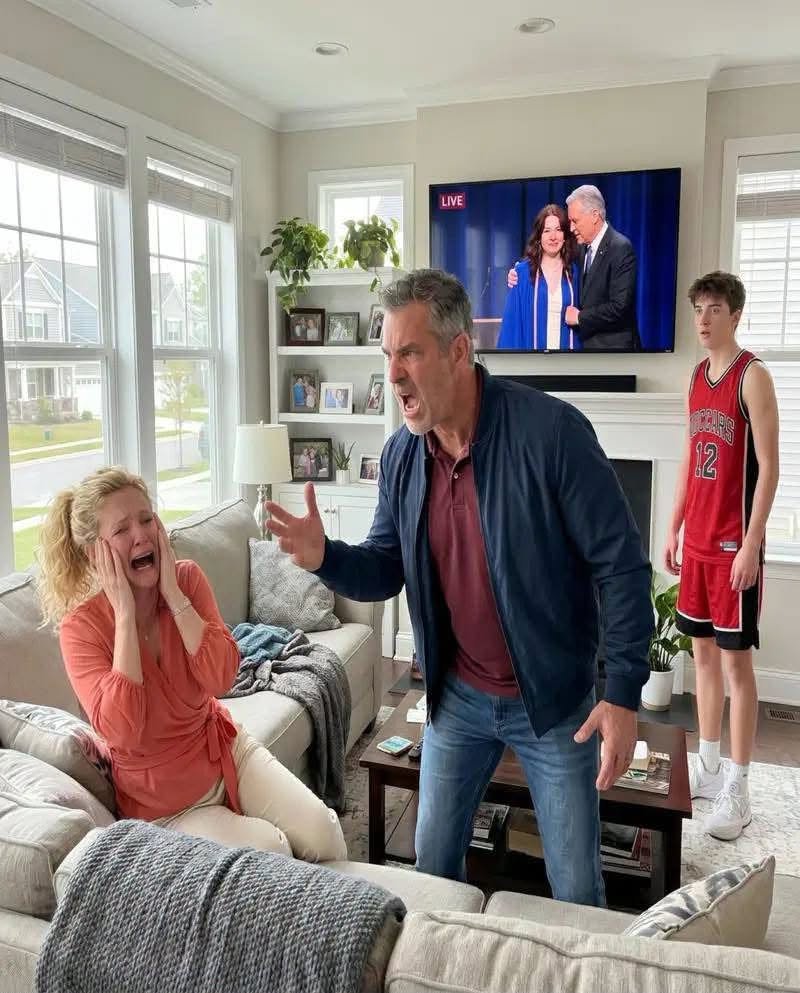
And when they finally came home, turned on the living-room TV, and saw the man standing beside me onstage, they froze.
My father had dismissed my graduation that morning.
“Valedictorian or not, Emma, it’s still just a bunch of teenagers wearing gowns and pretending the world owes them something,” Dad said casually as he spread butter over his toast.
Mom barely looked up from her phone.
“Tyler’s semifinal starts at six. There could be scouts there.”
Across the table, my brother spun his car keys around his finger with a smug grin.
“No offense, Em, but basketball actually matters.”
I said nothing.
For four years, I had worked for every achievement I had. I earned scholarships, tutored other students, worked part-time at the library, and survived on barely five hours of sleep most nights.
Tyler had failed algebra twice.
But he could dunk.
And apparently, that was enough for my parents to see him as the family’s best investment.
So, on the day I was supposed to celebrate one of the biggest achievements of my life, I went alone.
The graduation ceremony was held on Lakeside High’s football field beneath bright stadium lights. Families filled the bleachers, carrying flowers, balloons, and cameras.
I sat in the front row wearing my blue cap and gown.
Behind me were rows of empty seats.
The sign above them read:
FAMILIES OF HONOR STUDENTS
I tried not to stare at the empty seats that should have belonged to my parents.
Then Principal Harris stepped onto the stage.
“Emma Whitaker, valedictorian.”
Applause broke out.
At first, it was polite.
Then it grew louder.
I stood and walked toward the podium, gripping my speech tightly in my shaking hands.
For a moment, I considered reading the safe version.
The speech I had written about perseverance.
About gratitude.
About bright futures.
But then I looked at those empty seats.
And I changed my mind.
“My name is Emma Whitaker,” I began, “and tonight, I want to thank the people who showed up.”
The crowd became completely silent.
I spoke about Mrs. Alvarez, my English teacher, who kept snacks in her desk because she knew I sometimes skipped lunch to save money.
I thanked Mr. Coleman, the librarian, who allowed me to stay and study even after the library officially closed.
And I thanked Nina, my best friend, who recorded every debate tournament because she knew no one else would be there.
Then my voice became steadier.
“And I also want to thank the people who didn’t show up.”
A few people shifted in their seats.
“Because absence teaches us things too.”
I paused.
“It teaches you that sometimes strangers will applaud for you before the people at home do. It teaches you not to make yourself smaller just because the people who are supposed to love you loudly have chosen silence.”
Phones began rising throughout the crowd.
People were recording.
By the time I finished, the entire field seemed to be on its feet.
The applause was deafening.
I stepped away from the podium, trying to hold back tears.
And then I saw him.
At the edge of the stage stood a tall man wearing a charcoal suit. His hair was silver around the temples, and he was holding a bouquet of white roses.
I knew him.
Not personally.
But I knew his name from emails, interviews, and the scholarship letter that had completely changed my future.
He smiled as I approached.
“Emma,” he said quietly, “you were extraordinary.”
I could barely find the words to respond.
That night, my speech spread across social media.
By 11 PM, it was trending #1 on TikTok.
Thousands of people were sharing it.
Commenting.
Praising me.
Talking about the empty seats behind me.
Then, sometime later, my parents finally came home.
Tyler was limping, furious, and unusually quiet.
Mom and Dad walked into the living room without knowing what had happened.
Then someone pulled up the graduation video on the television.
Mom’s smile disappeared first.
Dad stared at the screen.
The video showed me standing onstage.
Then the camera moved.
And the man beside me came into view.
Dad leaned closer to the television.
The color slowly drained from his face.
He stared at the screen for several seconds.
Then he whispered,
“Wait…”
His eyes widened.
“Is that Daniel Pierce?”